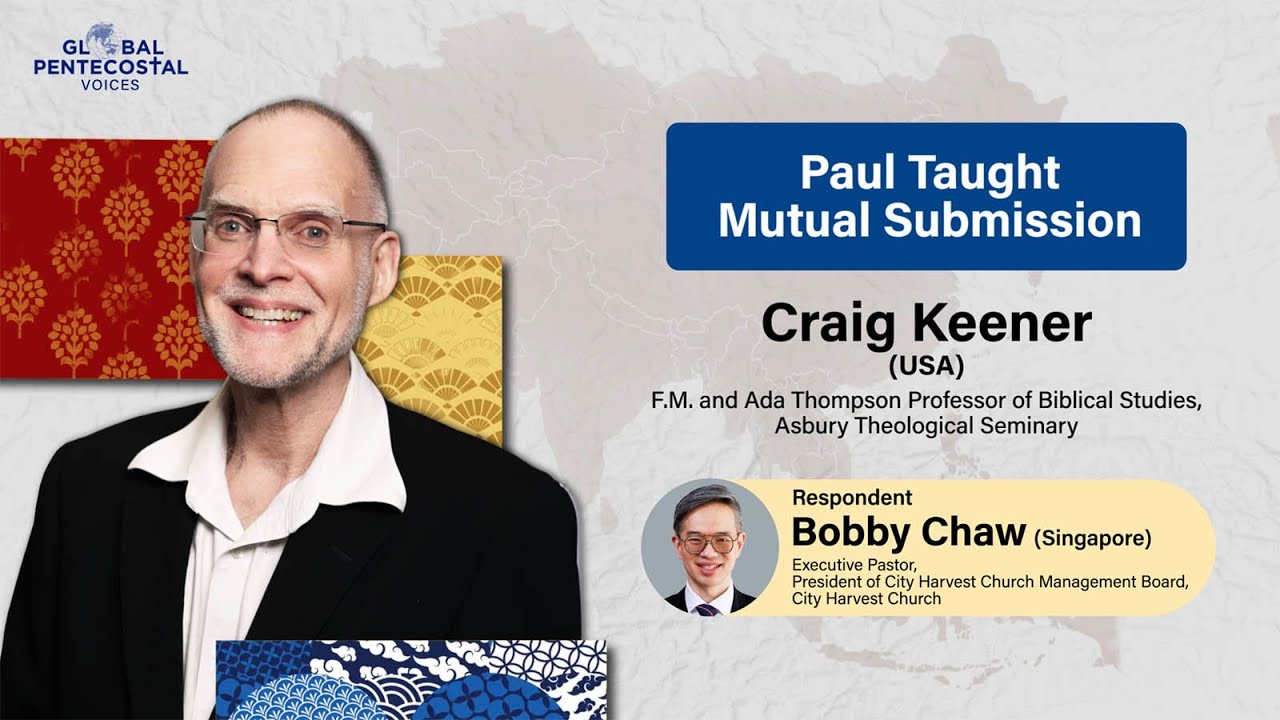
Craig S. Keener is the F. M. and Ada Thompson professor of Biblical Studies at Asbury Theological Seminary. He holds a PhD in New Testament and Christian origins from Duke University.
Dr Craig has authored nearly 100 academic articles and over 200 popular-level articles, along with 37 books—with more than 1.4 million copies in circulation. His IVP Bible Background Commentary: New Testament, which provides cultural background for each passage of the New Testament, has sold over half a million copies.
He is widely recognised for his work on cultural background studies, miracles, and commentaries on several New Testament books, including Matthew, Romans, 1 & 2 Corinthians, Galatians, 1 Peter, Revelation, John, and Acts. He is currently working on a multi-volume commentary on the Gospel of Mark.
Dr Craig serves as the New Testament editor for the NIV Cultural Backgrounds Study Bible and was president of the Evangelical Theological Society in 2020. His work has earned 13 national and international awards, including six from Christianity Today, and he continues to shape global biblical scholarship through both academic and popular-level contributions.
Paul Supported the Ministry of Women (APS 2025)
When Paul writes to former colleagues in Rome, he commends the ministries of more women than men; one of those he commends he even labels a fellow apostle. Paul, who ranks apostles and prophets as the most prominent ministries, allows for women to prophesy. His most common terms for ministry, diakonos (“minister,” “servant”) and sunergos (“fellow worker”), he applies to women as well as men. So why do two passages seem to limit women’s ministry? Although Mediterranean antiquity provided women less access to learning, Paul in both passages invites women to learn. The one passage that grammatically might prohibit women from teaching appears in the one set of letters where we know that false teachers were targeting women with their teaching. In general, then, Paul affirmed women in ministry; he restricted it only where necessary for specific situations.
The longest passage that some to support wives’ submission is Ephesians 5:22-33. But it belongs to a wider passage addressing submission, 5:21—6:9. This passage uses the ancient literary form of household codes. Although Paul contextualizes submission for his audience in the Roman empire, he qualifies the code in a specifically Christian way, explicitly framing the code with the call to mutual submission, both regarding marriage (5:21) and slavery (6:9). His invitation to wifely submission is grammatically inseparable from his invitation for mutual submission. This follows Jesus’s teaching that calls all Jesus’s followers to serve one another. Similarly, when Peter urges submission to every human institution (1 Pet 2:13), he gives examples within his culture of kings, slaveholders, and husbands (2:13—3:6), without expecting all cultures to continue monarchy, slavery, or patriarchal marriage.